“Sea, Poison” by Caren Beilin: Revisioning The One That’s Always Watching (BOOK REVIEW)
Revisioning The One That’s Always Watching
Hey, Alex! What have you been reading lately?
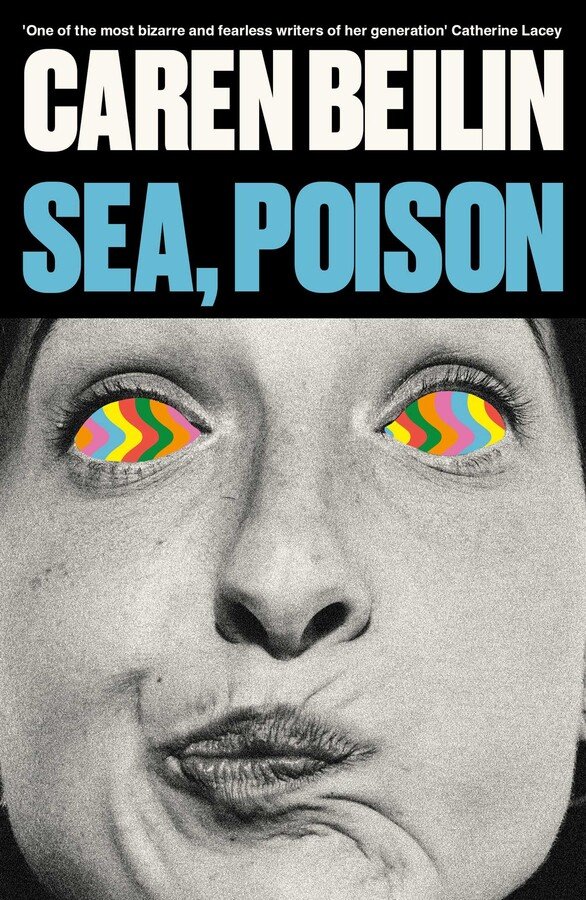
I just finished "Sea, Poison" by Caren Beilin and… wow. What a wild little book this is. Just under 150 pages, razor sharp, and disorienting, this is the kind of novella that sweeps you off your feet, spins you around a few times, and then drops you somewhere unfamiliar without bothering to explain where you are.
It’s bizarre, funny, uncomfortable, and completely uninterested in holding your hand, which made me even more excited to read it. Special thanks to NetGalley and Simon & Schuster for sending me an advanced copy.
Tell me more. What is the book about?
Cumin Baleen is a forty-something journalist working at Sea & Poison when she’s diagnosed with an autoimmune condition. To begin treatment, she undergoes a routine eye test that goes catastrophically wrong. A laser burns part of her brain, and suddenly Cumin loses the ability to form complex sentences. She can now only speak and write in short, simple statements.
This shift dismantles her entire life. She loses her job. She can’t finish her novel. Her boyfriend leaves. Medication after medication alters her emotional state, and Cumin goes from vigilant to aggressive to horny to existential until she no longer recognises herself.
Unable to articulate complexity, Cumin decides to do something else instead: she wants to show people the world through her eyes. She wants to expose the system that promises care but delivers damage and for everyone else to see poison.
What are some strong and weak points of the book?
This novella is so fun to read and unpack. And I say unpack, because I’m not convinced it wants to be understood. You’re fed nonsense, half-logic metaphors, and strange repetitions, yet somehow you still care and sympathise with Cumin. That tension between absurdity and emotional truth is where the book shines for me.
"Sea, Poison" is a direct response to Shūsaku Endō’s "The Sea and Poison", a novel about medical malpractice and unethical experimentation in a Japanese hospital during WWII. Beilin mirrors that brutality in a contemporary, intimate way: Cumin becomes a modern test subject, passed from drug to drug, body to body, never listened to.
One of my favourite formal choices is how the early chapters are titled after the medications Cumin takes. Each drug subtly reshapes her personality and perception. One makes her hyper-alert, another sexually charged, another nihilistic. Watching those emotional shifts unfold is a fascinating reminder that identity is fragile and chemically negotiable.
Everything in "Sea, Poison" is a metaphor. I won’t be surprised to hear it is semi-autobiographical. I mean, even the closeness between Caren Beilin and Cumin Baleen feels intentional, like a wink to the reader.
Despite all, I did struggle with one major thing. We’re told Cumin can only form simple sentences, but her story is narrated in reflective, complex past tense, filled with riddles and abstraction. I kept thinking how much braver (and more immersive) it would’ve been if the entire novel committed fully to that limitation. Say it was written in present tense and we could really feel Cumin’s frustration and linguistic restriction.
As it stands, it creates a slight disconnect. Not enough to ruin the experience, but enough to make the protagonist feel unreliable, as if her disability might be metaphorical rather than lived.
Any final thoughts? Should I read it too?
"Sea, Poison" is an ambitious, experimental novella about losing language, agency, and identity through medical failure. A writer who cannot write – not because of emotional blockage, but because her brain physically won’t cooperate. That loss is devastating. Writing is more than her job; it’s a part of who she is.
What I loved most is how the book shifts in its final stretch. Cumin stops trying to be legible. Stops trying to be believed. Stops caring about politeness or compliance. She moves through life drugged, passive, submissive… until she isn’t. Until she decides to live by her own terms, however fractured those terms might be.
"Sea, Poison" won’t be for everyone. It’s weird. It’s metaphor-heavy. It asks you to sit with uncertainty and resist answers. But if you enjoy unreliable narratives, satire, and fiction that feels like a puzzle missing half its pieces, then I’d absolutely recommend it.
Proceed with curiosity. And caution.
Thank you so much!! Are there any similar books that you can recommend?
If "Sea, Poison" scrambled your brain in a good way, try these:
🛌 My Year of Rest and Relaxation by Ottessa Moshfegh — a woman medicates herself into a year-long sleep as a form of control and quiet rebellion.
🩹 Little Scratch by Rebecca Watson — a day inside a woman's mind, spiralling, fragmenting, and resisting coherence.
📲 limaistyping…
rating: ☀️☀️☀️
tropes: 🤬 rage bait | 🌈 disability | 🍄 plunge to madness | ✍️ experimental prose | 🫦 original voice
read if you like: Sex and the City, French literature, chairs, Heart of Darkness, polyamory
look out for: 💬 English clauses | 🌻 the origin of oil | 🍇 Naked Grapes manuscript | 🧠 mushroom-growing brain | 📧 the letter “e”
Reading this is like laughing out loud after accidentally finding the answers to a crossword in a language you don’t speak.
tropes: 🤬 rage bait | 🌈 disability | 🍄 plunge to madness | ✍️ experimental prose | 🫦 original voice
read if you like: Sex and the City, French literature, chairs, Heart of Darkness, polyamory
look out for: 💬 English clauses | 🌻 the origin of oil | 🍇 Naked Grapes manuscript | 🧠 mushroom-growing brain | 📧 the letter “e”
Reading this is like laughing out loud after accidentally finding the answers to a crossword in a language you don’t speak.

Next
Next